
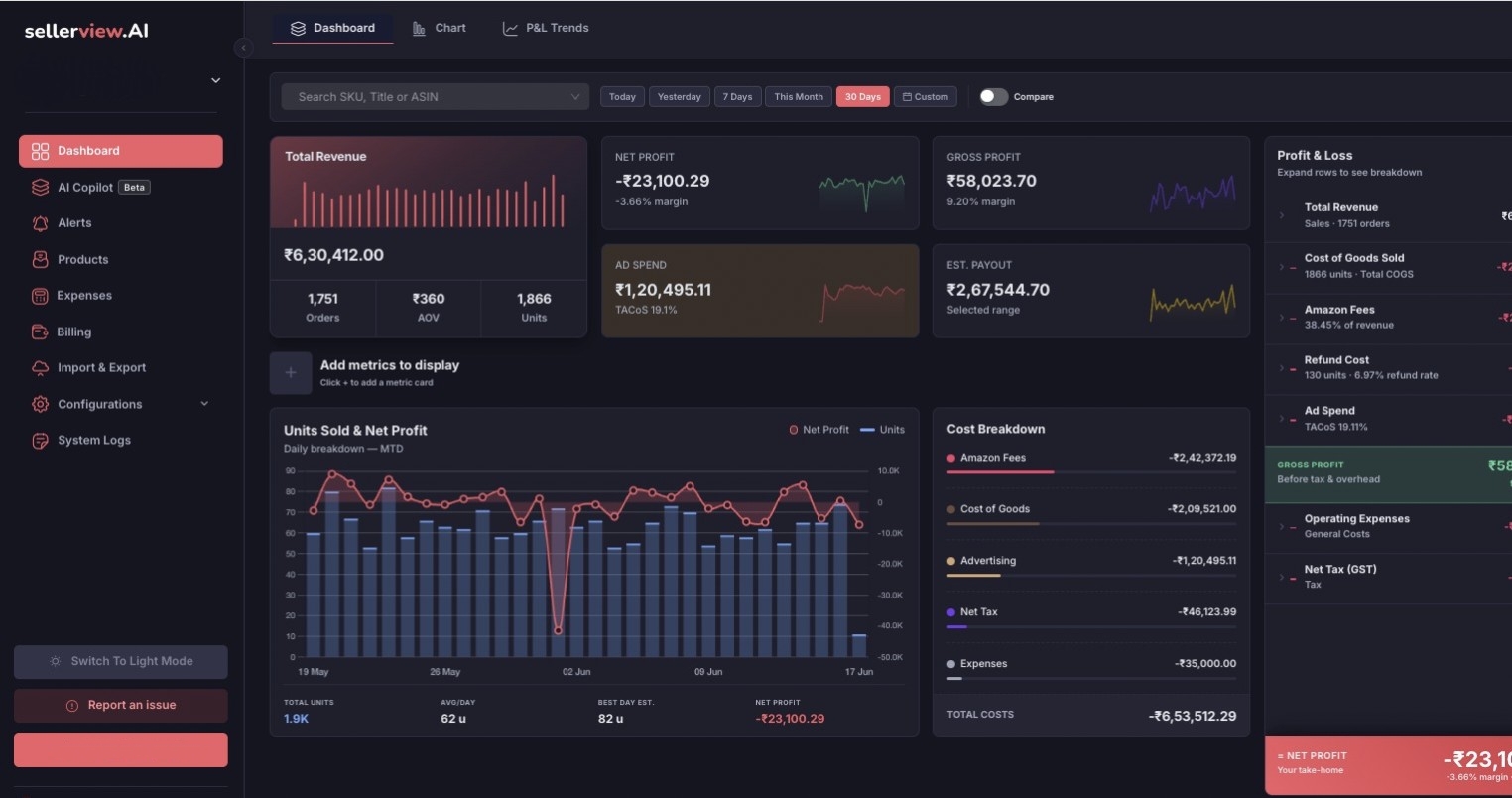
Overview
Sellerview.ai is a profitability analytics platform built specifically for Amazon sellers. It goes beyond the standard revenue and sales dashboards that most Seller Central tools already provide, and instead answers the one question that actually determines whether an Amazon business survives and grows: are you making real money after every fee, every ad dollar, and every return is accounted for?
Most Amazon sellers can tell you their total revenue in seconds. Very few can tell you, without opening five different reports and building a spreadsheet, exactly how much profit a specific SKU generated last month after Amazon referral fees, FBA fulfillment fees, storage costs, advertising spend, and refunds. That gap between "I know my sales" and "I know my profit" is where businesses quietly bleed money for months before anyone notices. Sellerview.ai was built to close that gap.
The platform pulls together data that normally lives in scattered places, Seller Central reports, advertising dashboards, spreadsheets, and sometimes a bookkeeper's notes, and turns it into a single, SKU-level view of true profitability. Instead of a wall of charts that requires a data analyst to interpret, Sellerview.ai is designed to surface direct answers: which products are actually profitable, which ones are quietly losing money, and where the specific leaks are coming from.
The Problem Sellerview.ai Solves
Amazon selling has gotten more complex every year. Referral fees vary by category. FBA fees change with size tiers and seasonal surcharges. Storage costs fluctuate based on inventory age and time of year. Advertising has grown from a simple sponsored products campaign into a stack of Sponsored Products, Sponsored Brands, and Sponsored Display campaigns, each with its own ACoS and TACoS behavior. Refunds and returns eat into margin in ways that rarely show up clearly until the monthly settlement report lands.
Individually, none of these costs look dramatic. Combined, they can turn a product that looks profitable at the top line into a product that is actually losing money on every unit sold. The typical seller finds this out only when they finally sit down and do a manual profit-and-loss breakdown, usually well after the damage has been done across hundreds or thousands of units.
This is the core problem Sellerview.ai addresses: sellers are scaling based on revenue and gut feel, not based on actual per-SKU profit data. They know what is selling. They do not always know what is worth selling.
Who Sellerview.ai Is Built For
Sellerview.ai is designed for Amazon-native sellers, not general eCommerce operators. The platform is intentionally focused rather than trying to be a multi-channel, all-purpose analytics tool. It is built for:
FBA and FBM brand owners doing meaningful, consistent volume, not brand-new sellers with a handful of orders
Sellers who are actively running Amazon PPC and need to know whether their ad spend is fueling profitable growth or masking a business that is not actually working
Multi-SKU sellers who need to compare products against each other to decide what to scale, what to leave alone, and what to kill
Amazon advertising agencies and consultants who manage multiple seller accounts and need a fast, reliable way to show clients real profitability, not just ad performance metrics
Operators who are data-overwhelmed, sitting on export after export of Seller Central and ad reports, without the time or tooling to turn that data into a decision
Sellerview.ai does not try to serve Shopify sellers, multi-channel retailers, or wholesale-only operations. It is intentionally narrow and Amazon-only, which allows it to go deeper on the specific cost structures, fee categories, and ad metrics that matter on that one marketplace rather than offering a shallow, generic view across many.
What Sellerview.ai Actually Shows You
At the center of the platform is SKU-level profit and loss visibility. Instead of looking at account-wide revenue or account-wide ACoS, which can hide serious problems inside a handful of SKUs, Sellerview.ai breaks profitability down product by product. This includes:
Real profit after every deduction. Revenue minus Amazon referral fees, FBA or FBM fulfillment costs, storage fees, advertising spend attributed to that SKU, and refunds or returns. The result is a number that reflects what the seller actually keeps, not what the top-line sales report shows.
TACoS and ACoS in context. Rather than presenting ACoS as an isolated advertising metric, Sellerview.ai connects it back to actual product profitability. A campaign can have an ACoS that looks acceptable in isolation while still being the reason a specific SKU is unprofitable once every other cost is layered in. TACoS is tracked over time so sellers can see whether organic sales are growing or whether the business is becoming more dependent on ad spend to sustain the same revenue.
Profit leak identification. The platform is built to flag where money is disappearing rather than just displaying raw numbers and leaving the seller to figure it out. This includes fee categories that are eating an unusually large share of a product's margin, return rates that are climbing on specific SKUs, and advertising spend that has stopped generating a profitable return.
Simplified, actionable insight instead of raw data dumps. A recurring complaint sellers have about existing analytics tools is that they generate more dashboards without generating more clarity. Sellerview.ai's design philosophy is the opposite: fewer charts, more direct answers. The goal on every screen is to help a seller quickly understand what to do next, not to admire a well-designed graph.
Why SKU-Level Matters More Than Account-Level
One of the most common mistakes Amazon sellers make is managing their business by looking only at account-level numbers: total revenue, total ad spend, overall ACoS. These numbers can look completely healthy while one or two SKUs are quietly losing significant money every single day, with the losses hidden inside an otherwise strong-looking average.
Sellerview.ai was built around the belief that profitability decisions have to happen at the product level. A seller running twenty SKUs might have five that are excellent performers, ten that are roughly breaking even, and five that are actively losing money once fees and ad spend are factored in. Looking at that seller's account-level numbers alone would never reveal which five products need to be fixed, discontinued, or repriced. Sellerview.ai is built to make that distinction obvious immediately.
This SKU-first approach also changes how sellers make growth decisions. Instead of asking "should I increase my overall ad budget," the more useful question becomes "which specific products deserve more ad spend, and which ones are burning budget without a profitable return." Sellerview.ai is designed to make that second, more precise question easy to answer.
Positioning Compared to Other Tools
The Amazon seller tools market is full of dashboards. Repricers show pricing data. PPC tools show campaign performance. Inventory tools show stock levels and forecasts. Most of these tools are good at what they specifically track, but very few of them connect the dots between advertising cost, fulfillment cost, and actual bottom-line profit at the individual product level.
Sellerview.ai does not try to replace every one of these tools. It is not a PPC bid management platform, and it is not an inventory forecasting system. Its focus is narrower and more specific: it exists to answer the profitability question that sits underneath all of those other tools. A seller can have well-optimized PPC campaigns, well-managed inventory, and a competitive price, and still not know whether the product is actually profitable once every real cost is included. Sellerview.ai is the layer that answers that question directly, using data that is normally scattered across other systems.
The positioning can be summarized simply: other tools show data, Sellerview.ai tells you what the data means for your bottom line.
The Core Promise
Sellerview.ai's value proposition rests on three connected ideas, and each is designed to build directly on the one before it:
Know your real profit. Move past revenue and gross sales numbers and see exactly what each product earns after every fee, every ad dollar, and every return.
Fix the leaks. Once profit leaks are visible, at the SKU level rather than buried in an account-wide average, sellers can act on them directly instead of guessing where the problem might be.
Scale with confidence. Growth decisions, additional ad spend, inventory reorders, new SKU launches, become based on which products have proven, sustainable profit margins rather than which products simply have the highest sales volume.
Common Use Cases
Deciding what to scale and what to kill. Sellers with large catalogs use Sellerview.ai to identify which SKUs deserve more marketing investment and inventory commitment, and which ones should be discontinued or repriced because they are not actually contributing to the bottom line despite decent sales volume.
Auditing ad spend efficiency. Rather than just watching ACoS at the campaign level, sellers use the platform to see whether their advertising spend is translating into genuine profit growth per SKU or simply propping up top-line revenue while margins shrink.
Preparing for due diligence in an acquisition or sale. Buyers and sellers of existing Amazon businesses use SKU-level profit data to verify that a business's reported profitability holds up once every real cost is included, rather than relying on a seller's self-reported P&L.
Agency reporting for client accounts. Amazon advertising and management agencies use Sellerview.ai to give their clients a transparent, product-level view of profitability rather than only reporting on ad performance metrics that do not, by themselves, prove the account is actually making money.
Catching problems early. Rising return rates, climbing storage costs on aging inventory, or an ad campaign that has quietly stopped being profitable are the kinds of issues that often go unnoticed for months in a standard revenue-focused view. Sellerview.ai is built to surface these earlier, before they compound into a larger problem.
What Makes Sellerview.ai Different
It is Amazon-only by design, not by limitation. Rather than trying to serve every sales channel shallowly, the platform focuses entirely on the specific fee structures, ad formats, and cost categories unique to Amazon, which allows for a more precise and relevant profitability picture than a generic multi-channel tool could offer.
It leads with the answer, not the dashboard. The product philosophy avoids the common trap of presenting more charts as a substitute for more clarity. Every view is built around helping a seller reach a decision quickly.
It treats SKU-level data as the default, not an advanced feature. Many tools bury per-product profitability behind account-level summaries or require manual filtering to get there. Sellerview.ai starts at the SKU level because that is where the real decisions get made.
It connects advertising performance directly to profitability outcomes. ACoS and TACoS are not treated as standalone marketing metrics but as inputs into the larger profit picture, which is closer to how a business owner actually needs to think about ad spend.
Who Benefits Most
Sellers who are already running meaningful ad spend and managing more than a handful of SKUs get the most value from Sellerview.ai, because that is exactly the point at which manual profit tracking in spreadsheets becomes unreliable and time-consuming. A single-SKU seller with modest ad spend can often track profitability manually without much trouble. A seller running dozens of SKUs across multiple ad campaigns, with fluctuating storage costs and return rates, cannot realistically do that by hand with any consistency.
Agencies managing multiple client accounts also see strong value, since the platform allows them to demonstrate real profitability impact to clients rather than only reporting surface-level advertising metrics that do not, on their own, prove an account is financially healthy.
How It Fits Into a Seller's Existing Workflow
Sellerview.ai is not meant to replace the tools sellers already use for pricing, PPC bid management, or inventory forecasting. It sits alongside them as the profitability layer. A typical workflow looks like this: a seller manages bids and campaigns in their PPC tool of choice, manages stock levels through their inventory system, and then checks Sellerview.ai to see whether those decisions are actually translating into real, sustainable profit at the SKU level.
This means a seller does not need to rip out their existing stack to get value from the platform. Sellerview.ai is meant to answer one specific, high-stakes question well, rather than trying to be a single tool that does everything adequately. That focus is intentional. Sellers who have tried all-in-one platforms often find that the profitability view gets diluted by everything else the tool is trying to do. Sellerview.ai avoids that by staying narrow.
A Note on Data and Accuracy
Profitability tools are only as useful as the accuracy of the cost data behind them. Amazon's fee structure changes periodically, referral fee percentages differ by category, FBA fee tiers shift with size and weight brackets, and storage fees vary seasonally. A profitability platform that does not stay current with these changes will quietly produce numbers that look precise but are actually wrong.
Sellerview.ai is built around keeping fee logic current with Amazon's published fee schedules, so that the profit numbers a seller sees reflect what Amazon is actually charging, not a stale snapshot from months earlier. This matters most for sellers in categories where referral fee percentages or FBA size tiers change, since even a small miscalculation compounds quickly across thousands of units.
Common Questions From Sellers Evaluating the Platform
Does this replace my PPC management tool? No. Sellerview.ai is not built to manage bids or campaigns. It is built to show whether the campaigns you are already running, however they are managed, are actually contributing to profit once every cost is accounted for.
Do I need a large catalog for this to be useful? The platform provides value at almost any catalog size, but sellers running a handful of SKUs with light ad spend can often track profitability manually without much difficulty. The clearest value shows up once a seller has enough SKUs and enough ad spend that manual spreadsheet tracking becomes unreliable or time-consuming to maintain.
Is this only for FBA sellers, or does it work for FBM too? Sellerview.ai is built to handle both FBA and FBM cost structures, since the fee categories and fulfillment costs differ meaningfully between the two, and a seller running a mixed catalog needs both handled correctly.
How is this different from my Seller Central Business Reports? Seller Central's native reporting shows sales and some fee data, but it does not typically combine referral fees, fulfillment costs, advertising spend, and returns into a single per-SKU profit number without significant manual work. Sellerview.ai is built to do that combination automatically.
Can agencies use this across multiple client accounts? Yes. Agencies managing several seller accounts use the platform to give clients a transparent, product-level profitability view rather than only reporting on advertising metrics that do not by themselves prove an account is financially healthy.
A Short Glossary for Context
For sellers newer to some of the terminology the platform uses, a few quick definitions help frame what Sellerview.ai tracks:
ACoS (Advertising Cost of Sale) measures ad spend as a percentage of the sales generated directly by that ad spend. It is useful for judging individual campaign efficiency but can hide the bigger picture if viewed in isolation.
TACoS (Total Advertising Cost of Sale) measures ad spend as a percentage of total sales, including organic sales that were not driven by ads. Tracking TACoS over time reveals whether a business is becoming more dependent on advertising to sustain the same revenue, which ACoS alone will not show.
Referral fee is the percentage Amazon takes from each sale, which varies by product category.
FBA fulfillment fee is the cost Amazon charges to pick, pack, and ship an order through Fulfillment by Amazon, based on product size and weight tier.
Storage fee is the monthly (or long-term, for aged inventory) charge Amazon applies for holding inventory in its fulfillment centers, which increases significantly for slow-moving stock.
Profit leak refers to any cost, whether fees, returns, or unprofitable ad spend, that is quietly reducing a product's margin without being obvious from a top-line revenue view.
Messaging Themes Used in Sellerview.ai's Own Marketing
For consistency, Sellerview.ai's own copy across its website, ads, and outreach avoids generic SaaS language such as "powerful dashboard" or "seamless platform," and instead leads directly with the seller's pain point. Recurring themes include:
"You're scaling. But are you profitable?" This is used to challenge the assumption that rising revenue automatically means a healthy business.
"Your P&L is lying to you." This reflects the idea that top-line numbers can look fine while specific products are quietly losing money.
"Find the leaks before they find you." This frames profitability tracking as a proactive discipline rather than a reactive cleanup after a bad quarter.
"Know which SKUs to scale, and which to kill." This ties directly back to the platform's core use case of making clear, product-level decisions rather than account-wide guesses.
"Stop guessing. Start knowing." A variation on the core tagline used in shorter-form messaging.
Who Should Not Use Sellerview.ai
In the interest of accurate positioning, Sellerview.ai is not the right fit for every seller. Brand-new sellers with only a few orders and no meaningful ad spend will likely get limited value, since manual tracking is still manageable at that scale. Multi-channel sellers looking for a single tool to track profitability across Amazon, Shopify, and other marketplaces at once will not find that here, since the platform is intentionally Amazon-only. Sellers looking for a bid management or automated repricing tool should look elsewhere, since Sellerview.ai does not manage campaigns or pricing directly; it measures the outcome of those decisions.
Closing Summary
Sellerview.ai exists because Amazon selling has become too complex for revenue alone to be a reliable signal of business health. Referral fees, fulfillment costs, storage charges, advertising spend, and returns interact in ways that are easy to miss at the account level and easy to catch once a seller looks at true profit SKU by SKU. The platform is built to give Amazon sellers, and the agencies that support them, a direct answer to the question that matters most: not "what did I sell," but "what did I actually keep." Stop guessing. Start scaling profitably.

Get Face Report is an AI-powered facial analysis and personal styling platform that helps users understand their facial features

Antique Scanner reads hallmarks, maker's marks and wear in your photos — and returns an honest identification with age and value ranges.

Turn Flat Images Into Editable Layers.
Turn any image into editable layers

Longruay - Official site: US$100 million, 30 days, one daily decision with AI briefings from Mira.

Life Path Calculator - trustworthy free numerology: verifiable math, honest Master Numbers, AI reading with refunds.
