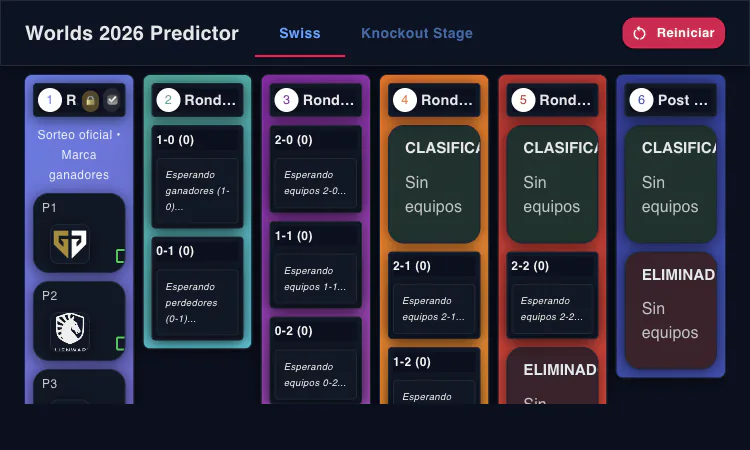
Worlds 2026 Predictor Vercel App can be understood as a small workflow engine for a fan-created tournament scenario. It begins with eight first-round matchup slots, each with a winner choice, then presents later groups that depend on the evolving record. A user enters decisions at the start of the path and inspects how the board organizes subsequent stages. This is different from a static bracket image: the visible controls make the visitor an active participant. The Worlds 2026 Predictor Vercel App is a focused interface for moving through a domain-specific sequence, with each decision tied to the tournament structure rather than to a generic form field.
The round-one area displays P1–P8 pairings with winner controls. The page also includes controls associated with official pairing status and locking round-one results. Later sections show record labels and waiting messages, which communicate that those areas are downstream from the first choices. The Reiniciar control offers a straightforward way to start another run. Together, these elements provide a legible interaction model: make an input, review the resulting progression, and reset when testing a different set of assumptions. A product description can document these user-visible behaviors without making assumptions about how state is stored internally. A closer look at Worlds 2026 Predictor Vercel App shows the same sequence of choices and later-stage groups.
The Swiss layout is built around records rather than a single line of advancement. Early groups include 1-0 and 0-1; later groups show combinations such as 2-0, 1-1, 0-2, 2-1, 1-2, and 2-2. The board also marks paths that end in qualification or elimination. This gives the user a state model that can be read directly from the interface. Waiting text indicates that a group is not yet populated. For a visitor evaluating the Worlds 2026 Predictor Vercel App, those labels explain the core logic more clearly than a generic statement that it is a bracket tool.
A prospective user can evaluate the workflow without assuming anything about the codebase. Confirm that the eight opening slots are visible, inspect how winner controls are presented, and follow the later record groups. Switch to Knockout Stage and check how the separate phase is represented. Then use Reiniciar if a fresh scenario is needed. This sequence tests the practical experience at the level a fan cares about: does the board make it clear what to do and where a choice leads? The title mentions Vercel, but deployment platform alone does not establish a framework, server design, persistence mechanism, or data source, so product copy should stay with observed behavior.
The inspected page displayed P1–P8 placeholders instead of named first-round teams, while later groups showed waiting or empty states. This means the page can demonstrate its interaction structure even when it does not yet contain all the information a fan would want for a completed prediction. A careful listing should not fabricate matchups, team identities, automatic odds, or live data. It should say that users can enter winners and follow the bracket path, and advise them to verify current event details separately. This is a precise description of what the Worlds 2026 Predictor Vercel App exposes and prevents a user from confusing a blank state with a confirmed tournament forecast.
Tournament paths are relational: one result determines which record group becomes relevant, and several paths may be active at once. A continuous board lets the user keep these relationships nearby instead of switching between notes or mentally recalculating every step. Numbered rounds provide orientation, while waiting states distinguish an incomplete route from a finished one. The separate knockout tab makes it clear that the tournament journey has another phase. These interface cues support reasoning without claiming that the product itself has an analytical opinion. The user supplies their assumptions; Worlds 2026 Predictor Vercel App makes the consequences easier to inspect.
Start on Swiss and examine the round-one section. When the pairings are known, select winners across the eight slots and watch how subsequent record groups become relevant. Review whether the qualification and elimination labels give you enough context, then open the knockout view. If you want to compare a second route, reset and modify one or two outcomes. This checklist is an ordinary user walkthrough, not a claim of formal testing. It tells a fan how to learn the interface in a few minutes and gives the product listing a useful level of detail. The Worlds 2026 Predictor Vercel App is easiest to understand by following one hypothetical from its first decision to its later stages.
The product concentrates on a single tournament-prediction task. It does not appear to be a general esports database or a customizable bracket builder for every competition. That narrow scope helps keep the user's attention on the Worlds 2026 progression. Fans who need official schedules or results should consult a source designed for that purpose; fans who want to map their own expectations can use this board as a scenario workspace. Its value lies in the connection between inputs and visible tournament groups. Worlds 2026 Predictor Vercel App is a direct way to explore that connection in a browser. A further look at Worlds 2026 Predictor Vercel App can help a fan decide whether this bracket workflow fits their event routine.
This browser-based product is a prediction companion for fans following the 2026 League of Legends World Championship. The page is titled Worlds 2026 Predictor and opens on a Swiss tab. Its purpose is to let a visitor enter choices, then follow how a tournament route could develop. It is not presented as a live score service or an official source of event facts. Instead, it provides a board where a fan can organize a scenario and see the stages together. The Worlds 2026 Predictor Vercel App makes a focused task accessible in a browser: move from a first-round opinion to a broader view of possible progression, and revisit the path when a different assumption seems worth exploring.
The opening section contains eight pairings marked P1 through P8. Each pairing presents two sides and controls for identifying the winner. The page labels this section as official round-one pairings and includes controls related to locking the pairing state and round-one results. On the inspected page, team labels appeared as placeholders instead of a fully named roster. That is useful context for anyone writing about or trying the product: the bracket structure is visible, while the visitor should verify whether the current page has the match information needed for a complete forecast. Users can still learn the interaction pattern by reviewing the first-round slots and seeing how the page is organized before making any assumptions.
After the opening round, the Swiss board separates teams by their records. Visible groups include 1-0 and 0-1, followed later by 2-0, 1-1, 0-2, 2-1, 1-2, and 2-2 paths. The interface also has qualification and elimination endpoints, including 3-0, 3-1, 3-2, 0-3, and 1-3 groups. These labels show why a Swiss format cannot be treated as one simple elimination ladder: several paths advance in parallel, and a team's record determines which route it follows. Waiting messages and empty states explain that later groups depend on earlier outcomes. The Worlds 2026 Predictor Vercel App puts those pathways into one view so a user can follow a scenario stage by stage.
A separate Knockout Stage tab sits next to Swiss in the top navigation. The header also contains a Reiniciar control, giving users an obvious way to begin a different set of choices. Together, those elements support repeatable what-if use: build one possible route, inspect the later stage, reset, and compare another idea. The visible controls suggest a straightforward fan workflow rather than a long configuration process. Product copy should describe that workflow while avoiding claims that are not established by the page, such as saved prediction histories, accounts, shared editing, live feeds, statistical probabilities, or automated analysis. The Worlds 2026 Predictor Vercel App is useful as an interactive board without needing to be characterized as a forecasting engine.
A practical visit starts on the Swiss tab. The user reviews the opening slots, identifies the matchup information they want to use, and chooses a winner for each pairing. They can then inspect the record groups, continue through subsequent rounds, and switch to Knockout Stage to view the later phase. If they want to test a different assumption, they use Reiniciar and start a fresh scenario. This creates a clear cycle of choosing, observing, and revising. Fans can make a favorite-led forecast, try a more surprising set of results, or focus on one decision and see how it changes the possible route. The Worlds 2026 Predictor Vercel App keeps the user's own reasoning at the center.
The product is suited to League of Legends esports viewers who enjoy bracket predictions, tournament formats, and discussion about possible outcomes. A casual fan can use the record groups to understand the progression, while a more involved viewer can compare several routes and debate the assumptions behind them. It can be useful before an event, during a watch-party conversation, or when someone wants to revisit a hypothetical after a result. The board is a companion for fan reasoning, not a promise that a particular outcome is likely. Visitors should use official event sources to confirm participants, pairings, rules, dates, and results. When described with those boundaries, the Worlds 2026 Predictor Vercel App has a specific and understandable role in an esports fan's toolkit.

Flying Roadster AI Video Generator uses car references and optional portraits to make a defined flight sequence, with selectable resolution, framing, credits.
Project Moon Life is a browser simulation where a resident’s health, sanity, resources, and relationships shift as each decision changes the next year.
Premium undetected game modifications, HWID spoofers, and free gaming tools designed for seamless performance, maximum stability, and account safety.
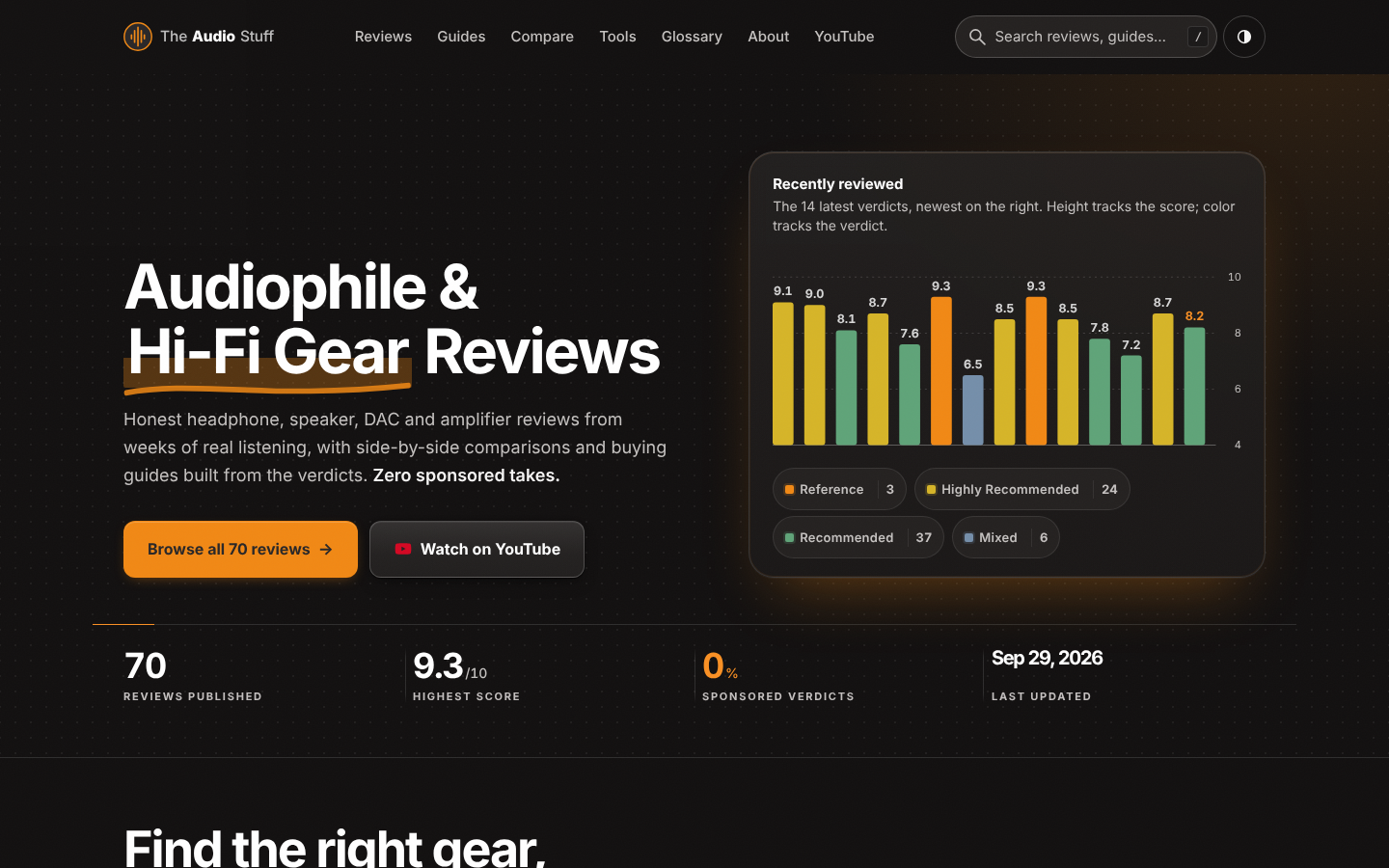
Find the right hi-fi gear for your ears, room and budget: ad-free reviews from weeks of listening, 12 buying guides, 35 comparisons and 17 free audio tools.

Get Face Report is an AI-powered facial analysis and personal styling platform that helps users understand their facial features

Antique Scanner reads hallmarks, maker's marks and wear in your photos — and returns an honest identification with age and value ranges.
