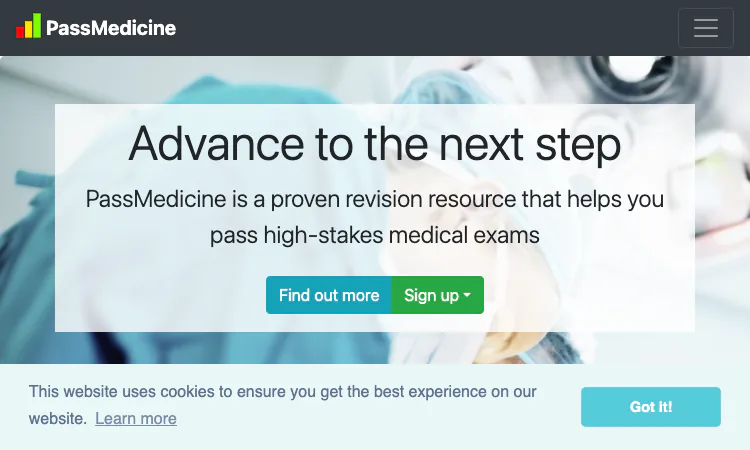
A getting-started guide should begin where a new user actually begins, so start here: you open passmedicine.com and see the PassMedicine homepage, headline "Advance to the next step". Below that headline, PassMedicine lays out its question banks as a grid of cards, each card naming an exam and quoting a question count. There is no onboarding wizard and no personality quiz. The PassMedicine model is that you already know which exam stands between you and the next stage of your career, and the site simply asks you to pick it.
That makes the first session with PassMedicine short. This guide walks through the steps in order: choosing your bank, learning the answering modes, working with explanations, building a review habit and using the readiness tools at the end. None of these PassMedicine steps is complicated, but the order matters, because each one sets up the next.
The full PassMedicine catalog covers every stage of UK medical training and a few exams beyond it. Medical students in years 1-3 choose the PassMedicine early-years bank, with over 4,700 SBA questions and an ANKI-style knowledge tutor. Students heading toward finals choose the PassMedicine finals and UKMLA bank, which holds over 12,000 single best answer questions plus OSCE and Prescribing Skills Assessment resources.
Postgraduate doctors pick by training path. The PassMedicine MRCP Part 1 bank holds over 5,400 SBA questions, three full mocks and a high-yield textbook; MRCP Part 2 Written adds over 2,950 more. GP trainees choose the PassMedicine MRCGP AKT bank, over 4,900 questions aligned to the updated 2025 RCGP curriculum, or the 2027 MSRA bank with over 3,600 Clinical paper questions and 300 Professional Dilemma questions. International graduates pick the PassMedicine PLAB Part 1 bank with over 5,000 questions and a full mock, or the USMLE Step 1 bank with 3,000-plus SBAs and spaced-repetition flashcards. There are also PassMedicine banks for DRCOG, the 2026 UCAT, the F2 Situational Judgement Test and the Pharmacy Registration Assessment. If your exam is not on the PassMedicine list, the homepage links to partner sites such as eMRCS, PassMRCOG, PassPaeds, MRCPsychMentor and FRCEMtutor that follow the same pattern.
Every PassMedicine bank offers the same two modes, and understanding them early saves weeks of wasted effort. Revision mode is for learning. You answer a PassMedicine question, submit, and the explanation appears at once, with per-question revision notes underneath and space for your own notes and a flag. Use PassMedicine revision mode for the bulk of your preparation, because immediate explanations are where the learning happens.
Timed tests are for rehearsing. A PassMedicine timed test imposes the clock, and the full mock exams reproduce the entire sitting. Do not start with these. The PassMedicine habit to build in week one is a daily block of revision-mode questions, twenty to forty of them, with timed tests layered in during the middle of your preparation and mocks saved for the final weeks. The mistake most PassMedicine beginners make is treating the bank as a test of what they know instead of a tool for finding out.
The single highest-value PassMedicine habit costs nothing extra: read the explanation on every question, including the ones you answered correctly. PassMedicine explanations justify the correct option and typically walk through why the plausible distractors are wrong, which is where marks are actually won in single best answer papers. A correct guess taught you nothing; the PassMedicine explanation closes that gap.
While reading, use the two annotation fields PassMedicine provides. Flag any question you were unsure about, so it joins your personal error bank for later review. Write a short personal note when your mistake had a cause worth remembering, such as a misread stem or a reliably tempting distractor. After a few months, a PassMedicine account accumulates hundreds of these notes, and they become the most personal revision document you own, worth rereading in the final fortnight.
Once you have answered a few hundred questions, the PassMedicine performance analysis becomes useful. It breaks your results down by topic, so your next PassMedicine sessions can target the weak rows instead of re-confirming the strong ones. Check it weekly, not daily; daily topic scores jitter too much to mean anything.
The other instrument is the candidate score histogram. PassMedicine updates it daily, and it shows where your score sits relative to other candidates preparing for the same exam, as a predictor of readiness. Two PassMedicine rules make the histogram honest. First, compare yourself only within your own exam's histogram. Second, watch the trend across weeks rather than reacting to any single session. A flat low position after a fortnight of real PassMedicine practice is information: change your plan.
In the last stretch, shift the PassMedicine balance. Work through the mock exams under strict timing, then spend your remaining PassMedicine hours on flagged questions and weak topics from the analytics, with the high-yield PassMedicine textbook for anything that keeps resurfacing. By exam week you should be maintaining, not learning. For current PassMedicine pricing and subscription terms, check the site directly, since the homepage does not list prices.
Before the first session, two traps worth naming. The first is bank-hopping: sampling the MRCP Part 1 bank for a week, switching to a partner resource, drifting back. Every PassMedicine feature, the flag history, the topic analytics, the histogram position, depends on a continuous record within one exam's bank, and hopping resets the record each time. Choose the exam you are actually sitting and stay in its PassMedicine bank.
The second trap is question-count vanity. A PassMedicine dashboard full of answered questions measures activity, not progress. The candidates who pass are usually the ones whose PassMedicine review folder and personal notes grew as fast as their question count, because those two artifacts are where the learning is stored. Count explanations read, not questions answered, and the PassMedicine record will point the same direction as your readiness.
If your exam is covered, starting PassMedicine this week beats starting next month, because every feature in this guide compounds with time. Pick your bank, set a daily question count you can sustain, and let PassMedicine accumulate the evidence for you.

Flying Roadster AI Video Generator uses car references and optional portraits to make a defined flight sequence, with selectable resolution, framing, credits.

Project Moon Life is a browser simulation where a resident’s health, sanity, resources, and relationships shift as each decision changes the next year.
Premium undetected game modifications, HWID spoofers, and free gaming tools designed for seamless performance, maximum stability, and account safety.
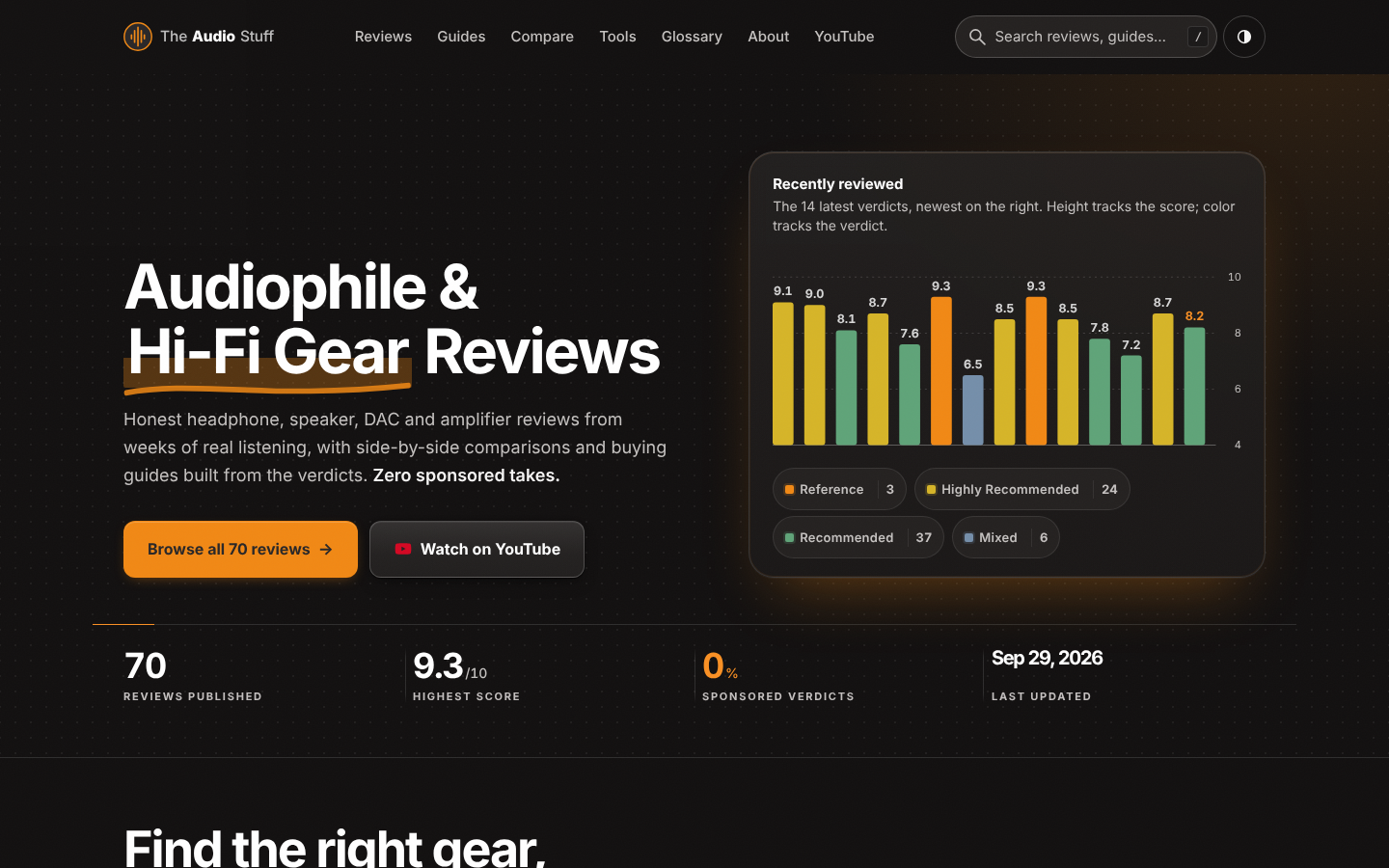
Find the right hi-fi gear for your ears, room and budget: ad-free reviews from weeks of listening, 12 buying guides, 35 comparisons and 17 free audio tools.

Get Face Report is an AI-powered facial analysis and personal styling platform that helps users understand their facial features

Antique Scanner reads hallmarks, maker's marks and wear in your photos — and returns an honest identification with age and value ranges.
