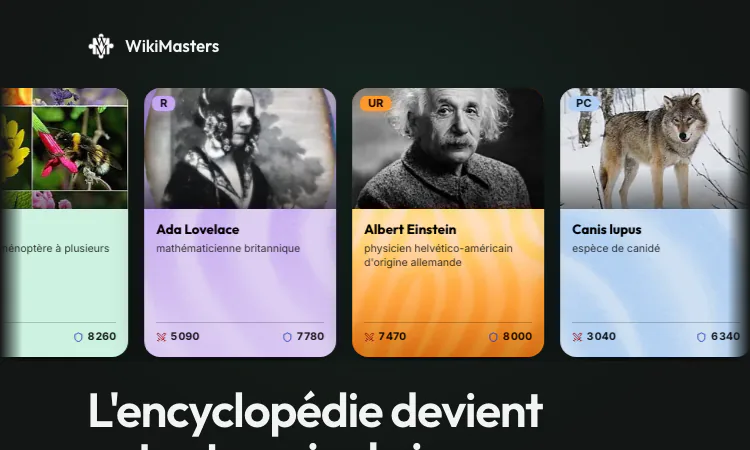
Every card in WikiMasters begins life as an ordinary encyclopedia page. The WikiMasters homepage makes this concrete with a card for the Sun — Soleil, the star at the center of the Solar System — carrying an R badge for rare and two numbers: 9 470 attack and 5 420 defense. None of those values were chosen by a designer. WikiMasters measured them from the French Wikipedia article about the Sun and printed them on the card as game statistics.
This walkthrough follows that single Sun card through every layer of WikiMasters, the free collectible card game operated by Shoobidoo Labs. You will see where the three numbers come from, how the card leaves a pack, what it does inside a WikiMasters quiz duel, and what happens when you pull a second copy. WikiMasters runs in French, and its card content is Wikipedia material published under the CC BY-SA license.
The rule sits on the WikiMasters homepage in a single sentence: article traffic sets rarity, article length sets attack, and article quality sets defense. The Sun card therefore encodes three separate measurements of one Wikipedia page. Its R rarity means the page draws heavy, steady readership. Its 9 470 attack reflects a very long article. Its 5 420 defense reflects a mid-tier assessment of the article's quality.
Rarity in WikiMasters comes in six tiers: C for common, PC for uncommon, R for rare, SR for super rare, UR for ultra rare, and L for legendary. Traffic is the only input that decides the tier. A page that enormous numbers of people look up, such as the Sun, sits high on that scale. A narrower page sits lower no matter how well it is written.
The consequence worth understanding early is that rarity and strength are different axes in WikiMasters. WikiMasters does not hand-balance cards the way a publisher balances a printed card game. WikiMasters reads the encyclopedia and lets the numbers fall where they fall, which produces some instructive mismatches. The Sun card is a good example of one.
Set the Sun beside two commons from the same WikiMasters lineup. Pompéi, the Roman city in Campania, is a common card with 4 030 attack and 7 770 defense. Abeille, the bee, is also common, with 2 070 attack and 8 260 defense. Both articles are shorter than the Sun's, so both WikiMasters cards attack for less. Both carry higher quality ratings, so both defend for more.
In a WikiMasters duel, the Sun card behaves like a glass cannon. It hits hard because its article is enormous, and it absorbs hits poorly because that article's quality assessment is only moderate. A common bee card from the same WikiMasters pack soaks damage better than the rare Sun. Meanwhile the WikiMasters card for Saturn appears as a legendary at 8 790 attack and 6 900 defense, and Albert Einstein appears as an ultra rare at 7 470 and 8 000, which tells you their Wikipedia pages draw even more traffic than the Sun's.
This is where WikiMasters rewards genuine encyclopedic curiosity. Noticing that well-tended natural science articles tend to produce high-defense commons, or that flagship astronomy pages produce legendaries, is real knowledge about Wikipedia. The WikiMasters card system converts that knowledge into a practical edge when you decide which cards to play and which to chase.
WikiMasters duels are quiz matches built from your own collection. The WikiMasters homepage describes the loop in one line: the quiz is drawn from your own cards, attack scores, and defense absorbs. When a question about the Solar System comes up and you answer it, the Sun card strikes with its 9 470 attack. When your opponent answers a question backed by their Pompéi, your Sun's 5 420 defense decides how much of that 7 770 attack reaches you.
Deck construction in WikiMasters follows directly from this. A WikiMasters deck stacked with long-article cards wins its own exchanges but bleeds points during the opponent's. Mixing the Sun with defensive commons such as the bee, or the cat card at 2 150 attack and 7 830 defense, covers both phases of a WikiMasters match. The dull common you nearly discarded is often the card that keeps you alive long enough to use your rare.
Duels also feed the social layer of WikiMasters. You can challenge a friend directly from a conversation, which turns a chat about a trade into an argument about who knows the encyclopedia better. A card like the Sun, drawn from a page almost everyone has visited, is exactly the kind of WikiMasters card that starts those arguments.
Pull the Sun a second time and you own a duplicate. WikiMasters gives duplicates three exits, and the first is the album. There you sort WikiMasters cards by tags such as Sciences and Histoire, pin favorites, and see at a glance which cards are still missing. A duplicate Sun adds nothing to WikiMasters album completion, which is precisely why it is worth something to another player.
The second exit is direct trading. You propose duplicates against the cards you lack and negotiate in the WikiMasters chat. The WikiMasters homepage shows a sample exchange in which one player offers a duplicate Cleopatra VII and the other counters with a Marie Curie, closing the deal without leaving the conversation.
The third exit is the WikiMasters auction house, where a card is listed under a countdown and other players bid. A sample WikiMasters listing shows the Great Pyramid of Giza, a legendary at 9 030 attack and 7 650 defense, standing at a bid of 1 240 with 7 offers and roughly two hours left on the clock. The Sun card would most naturally take the trade route: rare enough to interest a collector who missed it, low enough in tier that a WikiMasters buyer will not empty their balance for it. Judging which exit suits which duplicate is a small skill of its own, and the part of WikiMasters that feels least like a quiz and most like a market.
Individual WikiMasters cards also roll up into collective scores. WikiMasters guilds gather players under one banner, give them a shared space to talk, and climb a team ranking together; the homepage shows a sample guild of twelve members with individual contributions of 412, 388, and 301 points. Above the guilds sits a global WikiMasters leaderboard, with sample scores of 18 940, 17 205, and 15 880, alongside achievements to unlock and regular contests to enter.
This is the long-term home for the Sun card in WikiMasters. Once the WikiMasters album holds one copy and the duplicates have been traded away, the card keeps earning duel points every week it stays in your deck. WikiMasters is structured so that a card never really becomes trash: it either plays, completes the album, or converts into something you are missing.
WikiMasters is free to join, and the signup form is candid about its terms. You confirm that you are at least 18 and that you understand the cards come from Wikipedia and may include sensitive content. Card content in WikiMasters is published under the CC BY-SA license, the operator is Shoobidoo Labs, and the site states plainly that it is not affiliated with the Wikimedia Foundation.
WikiMasters will not suit everyone. The interface is French, the stats are mechanical rather than hand-tuned, and playing WikiMasters well means learning something about how Wikipedia itself works. For players who enjoy that premise — an encyclopedia turned into a card economy, where the Sun hits like a hammer and a bee guards like a wall — WikiMasters is a coherent and genuinely free take on it. For those who want an English interface or conventionally balanced cards, it will feel narrow. Either way, following one WikiMasters card from its Wikipedia page to its first duel is enough to understand the whole machine.
Flying Roadster AI Video Generator uses car references and optional portraits to make a defined flight sequence, with selectable resolution, framing, credits.

Project Moon Life is a browser simulation where a resident’s health, sanity, resources, and relationships shift as each decision changes the next year.
Premium undetected game modifications, HWID spoofers, and free gaming tools designed for seamless performance, maximum stability, and account safety.
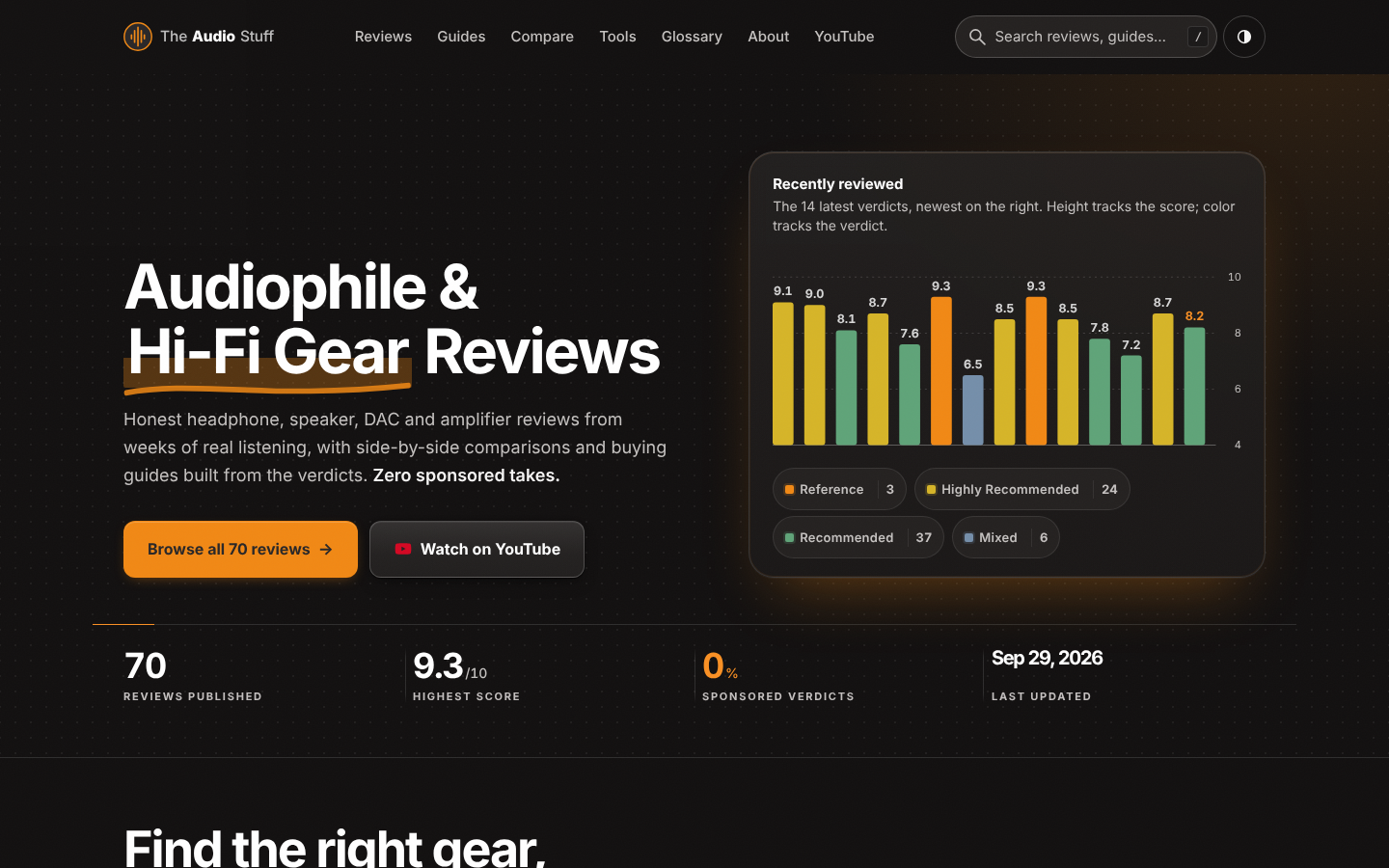
Find the right hi-fi gear for your ears, room and budget: ad-free reviews from weeks of listening, 12 buying guides, 35 comparisons and 17 free audio tools.

Get Face Report is an AI-powered facial analysis and personal styling platform that helps users understand their facial features

Antique Scanner reads hallmarks, maker's marks and wear in your photos — and returns an honest identification with age and value ranges.
